
Table of Contents
Summary
Indroduction
You have finally found a good supplier, picked your fabric type, and sent your design across. Then the knitted fabric manufacturer sends back a spec sheet with numbers like 180 GSM, 24 GG, and Ne 30 — and suddenly the excitement gives way to confusion. If this has happened to you, you are not alone. Most new buyers and even experienced clothing brand owners find these numbers overwhelming the first time they see them.
The truth is, these three terms — GSM, Gauge, and Yarn Count — are not complicated at all. Once you understand what each one means and how they connect to the final product, placing a fabric order becomes much more straightforward. You start asking the right questions, you avoid expensive sampling mistakes, and you build a much stronger working relationship with your manufacturer.
Why GSM, Gauge, and Yarn Count Matter for Every Order
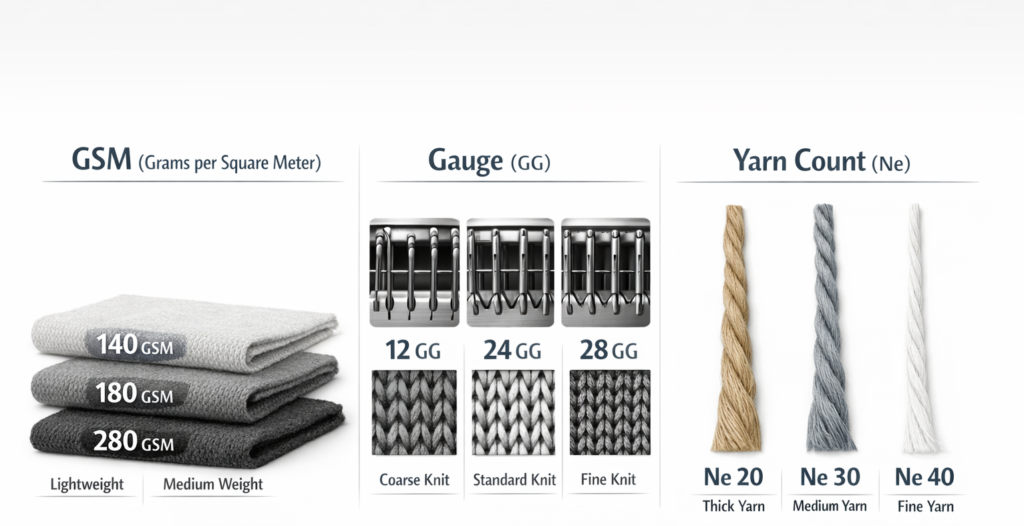
Think of these three values as the recipe for your fabric. Just like a cook cannot make the same dish twice without following the exact same recipe, a knitted fabric manufacturer cannot reproduce the same fabric without the exact same specs. GSM tells you how heavy the fabric is, gauge tells you how the knit is structured, and yarn count tells you how thick or thin the thread is. Together, they describe every important quality of a knitted fabric.
Getting even one of these numbers wrong can completely change the final product. Imagine you are ordering a summer t-shirt and you ask for 160 GSM fabric. But the factory works with 220 GSM as their default setting. The result will be a t-shirt that feels as thick and heavy as a sweatshirt — completely wrong for what you had in mind. This kind of mismatch is far more common than people realise, and it almost always happens because the specs were not communicated clearly at the start.
When you understand these three terms before approaching a knitted fabric manufacturer, you protect yourself. You save money by reducing back-and-forth sampling rounds. You save time by giving the factory exactly what they need to set up the machine correctly. And you deliver a better product to your customers because you know what you are ordering, not just what you hope you are getting.
What Is GSM? Understanding the Weight of Your Fabric
GSM stands for Grams per Square Meter. In the simplest possible terms, it tells you how much a one-square-meter piece of fabric weighs. The higher the GSM number, the heavier and thicker the fabric. The lower the GSM number, the lighter and thinner it is. That is really all there is to the definition — but the implications of that number are significant.
A fabric with 120 to 150 GSM is considered very lightweight. It is breathable, almost see-through when held up to light, and is ideal for summer tees, inner liners, and children’s wear in warm climates like most parts of India. A fabric in the range of 160 to 200 GSM is what most people think of as a standard t-shirt weight — comfortable for everyday wear across seasons. Once you move above 220 GSM, the fabric starts to feel noticeably heavier and warmer, making it suitable for sweatshirts, full-sleeve tops, and casual jackets.
Fabrics above 280 GSM are used for hoodies and fleece-lined outerwear, and anything above 350 GSM is typically reserved for very thick winter garments.
From a cost perspective, GSM directly determines how much yarn goes into a fabric. More weight means more yarn used, which means a higher material cost per meter. This is why two t-shirts made from the same cotton but with different GSM values will have noticeably different price points. When you request a fabric from a knitted fabric manufacturer, your target GSM is one of the very first things they will ask you — and for good reason.
As for how GSM is measured, it involves a simple process that every fabric testing lab uses. A circular cutter is used to cut a standardised piece of fabric, usually 100 square centimetres in area. That piece is then placed on a precision digital scale and weighed. The weight is then calculated and scaled up to represent one full square meter. The number you get is the GSM of that fabric. Reputable manufacturers test GSM multiple times during production to make sure it stays consistent throughout the entire roll.
What Is Gauge? Understanding the Structure of the Knit
Gauge, written as GG, refers to the number of needles per inch on a knitting machine. It controls how tightly or loosely the yarn is knitted together to form the fabric. A machine with more needles packed into each inch produces a finer, tighter, smoother fabric. A machine with fewer needles per inch produces a coarser, more open, and more textured fabric. This is one of the most important technical decisions a knitted fabric manufacturer makes for every order.
To understand gauge with a simple comparison, imagine two combs — one with fine, closely-set teeth and another with wide, spaced-out teeth. When you run yarn through the fine comb, it creates a smooth, even surface with small loops. When you run it through the wide comb, you get bigger loops and a more open, chunky structure. That is essentially what different gauge settings do to fabric.
In practical terms, a 7 GG machine produces chunky, open-weave knitwear — the kind of sweater where you can clearly see the individual loops. A 12 to 14 GG machine is used for mid-weight structured fabrics like polo shirt bodies and heavier jerseys. An 18 to 24 GG machine is the most common range for standard t-shirts and everyday knitwear, producing a smooth, even surface that holds its shape well. A 28 GG machine produces very fine, silky fabric used in premium t-shirts, seamless sportswear, and high-end fashion knits.
Gauge also has a direct relationship with how the fabric stretches and how it drapes on the body. A high-gauge fabric tends to have a more controlled stretch and a cleaner fall, which is why it is preferred for fitted garments and printed t-shirts where dimensional stability matters. A lower gauge fabric stretches more freely, making it feel relaxed and casual. Importantly, the same yarn can look and feel completely different depending on the gauge it is knitted on which is why you cannot separate gauge from the other two specs when placing an order.
What Is Yarn Count? Understanding the Thickness of the Thread
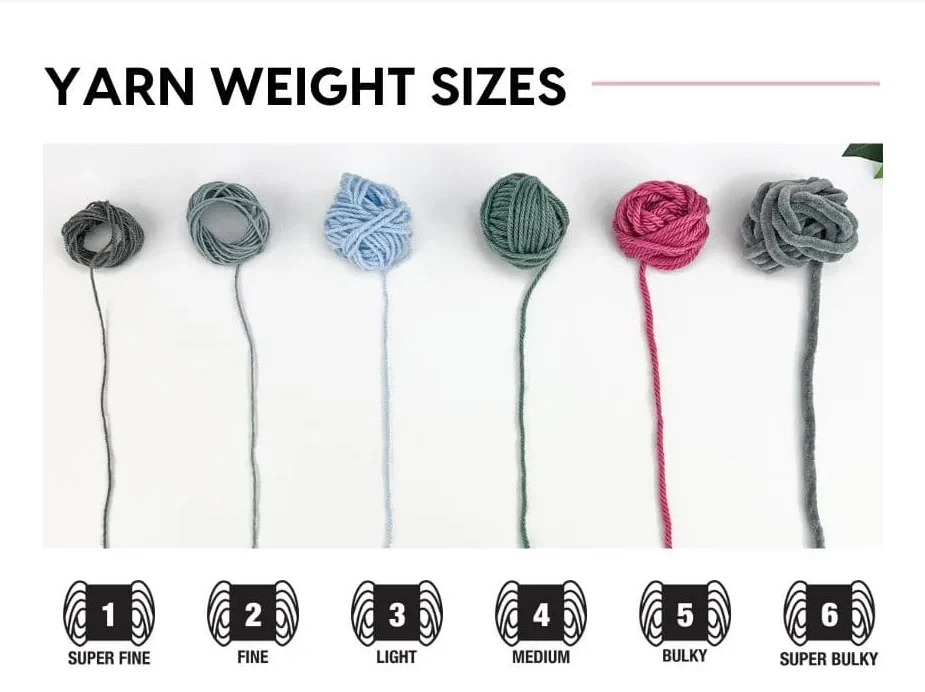
Yarn count tells you how thick or thin the yarn is. It is the foundational ingredient in the fabric recipe — the raw material from which everything else is built. A helpful way to think about it is to imagine two types of thread: a thick, sturdy thread and a fine, delicate thread. Both are threads, but the fabric you knit from each of them will look and feel completely different.
There are two main counting systems used in the textile industry. The Ne system, which stands for English Count, is the most commonly used system for cotton knit fabrics in India and is the one you will encounter most often when working with Indian manufacturers. In the Ne system, a higher number means a finer, thinner yarn — so Ne 40 is finer than Ne 30, and Ne 30 is finer than Ne 20. The second system, called Nm or Metric Count, is used more in European countries and technical fabric applications, but you are unlikely to need it unless you are specifically sourcing from European mills.
For most buyers working with knitted fabric manufacturers in India, the Ne count is the one to focus on. Ne 20 yarn is thick and sturdy, used for heavy-duty garments, workwear, and thick fleece. Ne 30 is the most commonly used count in Indian knitwear production — it offers a balanced combination of softness, durability, and cost-efficiency that makes it the default choice for everyday t-shirts and casual tops. Ne 40 produces a noticeably softer, finer fabric and is used in premium t-shirts, activewear, and garments where a smooth hand feel is a priority.
Counts above Ne 50 are considered very fine and are used in luxury knitwear and high-end fashion segments.
The relationship between yarn count and cost is straightforward — finer yarn is more expensive because it takes more effort and better quality raw material to spin. However, finer yarn also produces a more comfortable, premium-feeling fabric that consumers are willing to pay more for. When you specify your yarn count to a manufacturer, you are essentially deciding where your product sits on the quality-to-cost spectrum.
How GSM, Gauge, and Count Work as a System
Understanding each of these three terms individually is useful, but the real insight comes when you see how they work together. GSM, Gauge, and Yarn Count are not independent variables — changing one of them will always affect the others. Experienced knitted fabric manufacturers think of them as a connected system, and you should too.
A simple analogy helps here. Think of a knitted fabric like a woven basket. The thickness of the cane strips is the yarn count. The spacing between the strips is the gauge. And the overall heaviness of the finished basket is the GSM. If you use thicker cane (lower count), the basket naturally becomes heavier. If you weave the strips closer together (higher gauge), the basket becomes denser and stronger. The final weight (GSM) is always the result of both decisions working together.
To give a practical example, suppose you want to produce a 180 GSM single jersey t-shirt — one of the most popular fabric specs for everyday Indian casualwear. A manufacturer would typically achieve this by selecting Ne 30 combed cotton yarn and setting the machine to 24 gauge. The combination of that yarn thickness on that machine setting naturally produces fabric in the 175 to 185 GSM range, which is exactly where you want to be.
Now, what happens if you switch from Ne 30 to Ne 20 yarn — which is thicker — on the same 24 gauge machine? Your GSM will increase to around 210 to 220 GSM because more yarn is being packed into the same structure. Conversely, if you move to Ne 40 yarn on the same machine, the GSM will drop to around 140 to 150 GSM because the yarn is finer and lighter. This is exactly the kind of relationship that a good knitted fabric manufacturer will walk you through before finalising your specs, and it is why all three values must always be confirmed together.
Common Mistakes Buyers Make — and How to Avoid Them
Even experienced buyers make spec-related mistakes when working with a new manufacturer or entering a new fabric category. Most of these mistakes come not from a lack of effort but from simply not knowing what to specify.
The most frequent mistake is ordering fabric by GSM alone, without specifying gauge or yarn count. This gives the manufacturer too much freedom and almost guarantees a mismatch. A 180 GSM fabric knitted on a 12 GG machine with Ne 20 yarn will feel completely different from a 180 GSM fabric on a 24 GG machine with Ne 30 yarn — even though the GSM is identical. Always specify all three values together.
Another common mistake is skipping the pre-production sample. It is tempting to jump straight to bulk when you have a tight deadline, but a physical sample is the only way to verify that your specs are being met. Requesting a sample adds a week or two to the timeline but saves you from an entire bulk production run that does not meet your standards. No reputable knitted fabric manufacturer will push back on a sample request — and if one does, that is itself a warning sign.
Many buyers also confuse woven fabric standards with knitted fabric standards. A 200 GSM cotton poplin woven shirt and a 200 GSM single jersey t-shirt are completely different in feel, drape, and structure. The same GSM number does not mean the same fabric experience across different constructions. Always confirm which fabric type your GSM benchmark refers to before communicating it to your manufacturer.
Quick Reference: Fabric Specs by Product Type
| Product Type | GSM Range | Gauge (GG) | Yarn Count (Ne) | Best Use |
|---|---|---|---|---|
| Basic T-Shirt | 160–180 GSM | 24 GG | Ne 30 | Everyday casualwear |
| Polo Shirt | 180–220 GSM | 18–24 GG | Ne 30–40 | Smart casuals, uniforms |
| Sweatshirt / Hoodie | 280–320 GSM | 12–14 GG | Ne 20 | Winterwear, loungewear |
| Fleece Jacket | 300–400 GSM | 7–10 GG | Ne 10–16 | Heavy winter outerwear |
| Fine Knitwear | 120–150 GSM | 28 GG | Ne 40–60 | Premium lightweight tops |
How to Communicate Fabric Specs to Your Manufacturer
Knowing these three terms is only valuable if you can put them to use. The most practical way to do that is by writing a clear, complete fabric spec sheet before you reach out to a manufacturer. A spec sheet does not need to be a complicated technical document — even a simple one-page summary with the right information is enough to get accurate pricing, correct sampling, and smooth production.
At a minimum, your fabric spec sheet should include the fabric construction type (such as single jersey, interlock, rib, or fleece), your target GSM with an acceptable tolerance of plus or minus 5 grams, the machine gauge, the yarn count and fibre content, the required fabric width, and any finishing treatments needed such as compacting, enzyme washing, or softener application. When all of these details are in one place, a manufacturer can give you an accurate quote and set up the machine correctly from the very first sample.
The difference a good spec sheet makes is significant. Buyers who send complete specs typically need only one or two sampling rounds before approving bulk production. Buyers who send incomplete specs can end up going through five or more rounds, each one costing time and money. If you are unsure what values to put on your spec sheet, the cheat sheet table above is a good starting point — and your manufacturer should always be willing to advise you from there.
Your Pre-Order Fabric Spec Checklist
Before placing your next fabric order, confirm these six items. Having them all ready will give you a smooth ordering experience and help your manufacturer deliver exactly what you are expecting.
- Fabric Construction: Single jersey, interlock, rib, fleece, or other knit structure.
- Target GSM: Your required weight in grams per square meter, with a +/- 5 tolerance.
- Machine Gauge: The GG value required for your fabric structure and texture.
- Yarn Count: The Ne count and whether you need carded or combed quality.
- Fibre Content: 100% cotton, cotton-elastane blend, polyester, or other composition.
- Finishing: Compacted, enzyme washed, softener applied, or as-knitted grey fabric.
Final Thoughts
GSM, Gauge, and Yarn Count might look like three small numbers on a spec sheet, but they carry the full story of your fabric. They determine how the fabric feels in a customer’s hands, how it performs after repeated washes, how it holds a print, and how much it costs to produce. Getting them right is not just a technical requirement it is a direct investment in the quality and reputation of your brand.
If you are still unsure about which specs are right for your product, the team at Texoraglobal is here to help. As experienced knitted fabric manufacturers, we guide you from the very first spec to final bulk production no confusion, no guesswork.